
Celebrating Michel Petrossian: Composer-in-Residence Shares Insights from ModComFest 2025
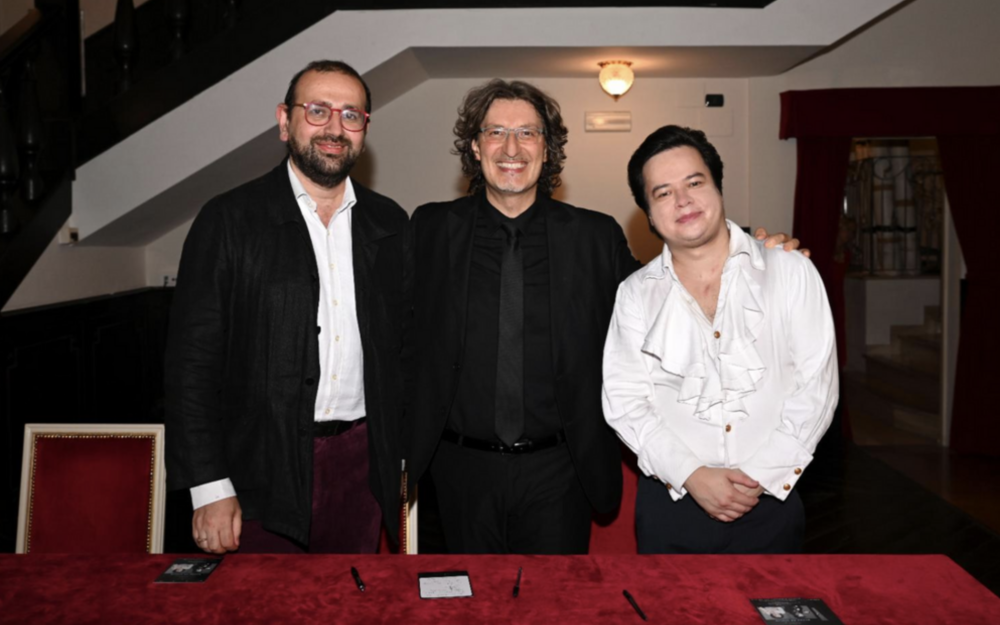
This year, the entire festival is devoted to French-Armenian composer Michel Petrossian, whose works are deeply rooted in ancient civilisations and spirituality while remaining strikingly contemporary in language and scope. Over the course of six concerts in a variety of historic venues, audiences are being presented with a wide-ranging portrait of his oeuvre, from chamber music and solo works to vocal music and ballet.
The festival opened at the historic Teatro Marrucino in Chieti with Two Voices, One Flame, a concert headlined by violinist Roman Kim and pianist Giuliano Mazzoccante. Following the event, we sat down with Petrossian, who shared his thoughts on the experience of seeing his music placed so prominently at the heart of ModComFest 2025, as well as his broader reflections on creativity, tradition, and the role of such festivals in today’s classical landscape.
This year’s edition of ModComFest is dedicated entirely to you and your music. How does it feel to have an international festival focus so closely on your artistic journey and creative legacy?
“Well, first of all, it’s the greatest privilege to have such exposure, which is rare, and I’m very, very grateful for this opportunity. It allows me to put my works in perspective, to see where my strong parts are, and what can be changed. It is also an opportunity to premiere new pieces, like Armenian Rock, which was just performed in Chieti, because it gives you the chance to see how audiences react. It’s a way to verify the pertinence of my works and help me decide what I want to do next, so it’s very inspiring for the future as well.”
After experiencing the opening concert of ModComFest 2025, what are your impressions of how your works were presented and received tonight?
Chieti is a wonderful city, full of the most generous, gentle, courteous and nice people that I’ve met in a long time. I don’t think that contemporary music is frequently presented in this very famous theater, but it was a very nice experience to see how the public responded, and I got the chance to say a few words in Italian to present the works and then to speak with the audience members after the performance. It was also very interesting to connect with Giuliano Mazzoccante, who is a great musician, but also the heart and personality of this city, and then to see Roman Kim, who is a great virtuoso, taking on such a piece as Stilleven for solo violin. So it is very interesting to see how different people can respond to my pieces, especially when you have something like Armenian Rock, which is inspired by my love of progressive rock, being followed by Roman’s encore with references to Yes and Michael Jackson. We are mixing styles; resolutely contemporary music as far as I'm concerned, but at the same time open to the world, the classical tradition, but also the rock and pop tradition, which I incorporate in my music just like the composers of the 17th, 18th, and 19th centuries did with the popular music of their time as well”.
What was it like hearing artists like Roman Kim and Giuliano Mazzoccante interpret not only your music but also works by Shor, Tartini, and Paganini alongside it? Do you see dialogues forming between these different worlds?
“It's always very interesting to have this eclectic kind of programming, because there were works like Tartini’s Devil’s Trill Sonata, one of the most famous pieces for virtuoso violinists, a tradition which Roman Kim is of course deeply inscribed in. I think I've never heard, for example, the Campanella of Paganini played at such a level; I think what Roman does is comparable and sometimes even more impressive than the biggest standard! Then there were his own pieces, which are very inspired by romantic music, and then the neo-romantic or neo-classical piece of Alexey Shor, which gives us another type of approach to the violin. Maybe my music seemed a bit different sometimes, in comparison, but I think that presenting such different combinations, different styles, is interesting for the audience. In my young years in Paris, there was a kind of stylistic racism where only a certain type of contemporary music was allowed, but I really don't think this way. I don’t think there is anything which is inferior or superior; I think audiences have a right to decide what they like and what they wish to listen to, and it was nice to present different types of works. Ultimately, each piece gained in comparison with the others honestly, and I was happy to be in this context with different styles, different languages, different approaches, and different degrees of investment in the virtuosity as well!”
As someone whose music often draws inspiration from ancient civilisations and spirituality, did you feel that tonight’s performance at the historic Teatro Marrucino in Chieti added another layer of resonance?
“It was amazing because as you mentioned, my music is rooted in this continuity with tradition. I'm really interested in ancient civilizations; I've traveled the world and drawn inspiration from those cultures, so of course, to be in Chieti, a town older than Rome, and to be performed in one of the oldest theaters in Italy, was a thrill! Curiously enough though, my music, especially the premiere of Armenian Rock, was turned to the future to some extent, because it’s inspired by progressive rock. So there was this contrast between Chieti – such an ancient place – and then the modernity of my music and its connection with contemporary popular music! Contrast reveals light, as they say, and I think something of this order took place here within the public that was present.”
ModComFest aims to celebrate contemporary composers while placing them in dialogue with tradition. How do you see your music fitting within this mission?
“That’s a very important question. I think the concert in Chieti was a perfect example of how one can manage the presence of contemporary writing within the traditional context. Even though the programme was mostly modern, the languages of Roman’s pieces and Shor’s works are perhaps more connected to tradition than mine. And then you have to be clever in the programming so that you can craft it out in a way that gives audiences this link that they can immediately appreciate. So it was a very nice blend of styles and its connection to the tradition.”
The festival still has several concerts to come in Paris and beyond. Are there any upcoming events or works being performed that you are particularly excited about?
“I really cannot single out one preference to another, because the most interesting thing, and that’s the greatest opportunity I have with this festival, is to see how pieces can dialogue with each other, like different gems on the same diadem, even if they weren’t crafted in this way, and it’s very interesting for me to hear pieces that have been performed many times again with a very different background; it is a way to feel the living aspect of my music. There are many thrilling moments to come. We are very happy to have something special on the 28th of September, because there is a film that has been made about my work in the realm of film music by Bernard Sasia, and it's another way for audiences to delve deep into the creative process. And in the same concert we will have the ‘Vénus de Lespugue’ for viola solo, which is maybe one of the most complicated and demanding pieces that I've ever written for Karine Lethiec, who will be presenting it.
Then there is the concerto for cello on 2nd October which has never been performed in public before. I'm so happy to work with Léo Margue for this; he is an incredible conductor, who I've worked with many times. He's a very good friend of mine and we are really connected aesthetically, humanly, and philosophically about music. I've also been given the opportunity to connect with many soloists who will play on October 2nd, they're all incredible and all very eager to give their very best, and I can happily put all my faith in them because they are really great performers in every way. After that comes maybe the most complete spectacle - our ballet, ‘Sept, les anges de Sinjar’, which I wrote with Aram Hovhanissyan, and which will be directed by Bruno Mantovani who is a great composer, conductor, and director of the Paris Conservatory. It was presented in a very prestigious venue three years ago in Monaco; we played it again in Avignon’s opera, and now it will be the third representation in this great theatre at Saint-Maur, and it's going to be a wonderful experience! Then we'll be concluding with a last concert in Italy, bringing the festival to a complete circle since we started in Chieti, and that's very exciting for me as well.”
How important do you think initiatives like ModComFest are for the growth of classical music, especially for new audiences?
I think you can never overestimate the importance of such an initiative. It's absolutely fundamental for our time because I really do believe that composers must be at the centre of musical life today. We cannot just be within the repertoire, no matter how great it can be, because the vitality of a civilization, the vitality of the culture, is in the creative process. On the other hand, we know that contemporary creation is sometimes divorced from audiences. There may be many reasons for this, but I think one of the main reasons is that composers are not confronted. Taking on the challenge to present pertinent works within a highly professional context, while also preparing programmes that mingle tradition with contemporary while concentrating on the portrait of a composer is a really great test, and also a really great opportunity for people to connect with the musicians, and with the composers, and for the composer to be confronted with different performers in those concerts!
So I think it's absolutely crucial to have such initiatives, and I don't know if they have any equivalence. Here we have something which runs for a month, across different geographical areas, different contexts, different places, different audiences… it’s different from anything else, and it’s also a catalyst, because it lights a fire for the musicians. They see sense in what they are doing and also the opportunity to do what they want. For me it was a very kind and nice reminder of some musicians who really enjoy my music, and are really ready to defend it. So it's very positive for the composer of course, but also for the audiences, because you cannot escape contemporary creation; for the musicians because they can realise the possibilities of collaboration; and for the cultural life of these places, because it connects cultures and civilisations. It's a celebration of humanity at its best, and it's a really correct, new, progressive, audacious way to present creation to modern audiences. I think we cannot overstate how important it is, how great it is, how inspiring it is, and how important it is, so thank you very much to Konstantin Ishkhanov, who contacted me to propose it!
ModComFest 2025 will run until the 17th of October, with various concerts in venues across France and Italy. For more information, and to purchase tickets, visit the official website at petrossian.modcomfest.com now.
